Updates arrive in inconsistent formats
Different consultants and project teams create a fragmented management picture.

Create a consistent operational view across projects without needing to manage every contractor task. Taskeeper helps owner and developer teams keep the signals that matter—status, budget, payments, risk, compliance and reporting—visible together.
Different consultants and project teams create a fragmented management picture.
Budget and payment information can look healthy while delivery risk is increasing.
Each project maintains its own registers and reporting cadence.
Teams repeatedly rebuild status views for internal stakeholders.
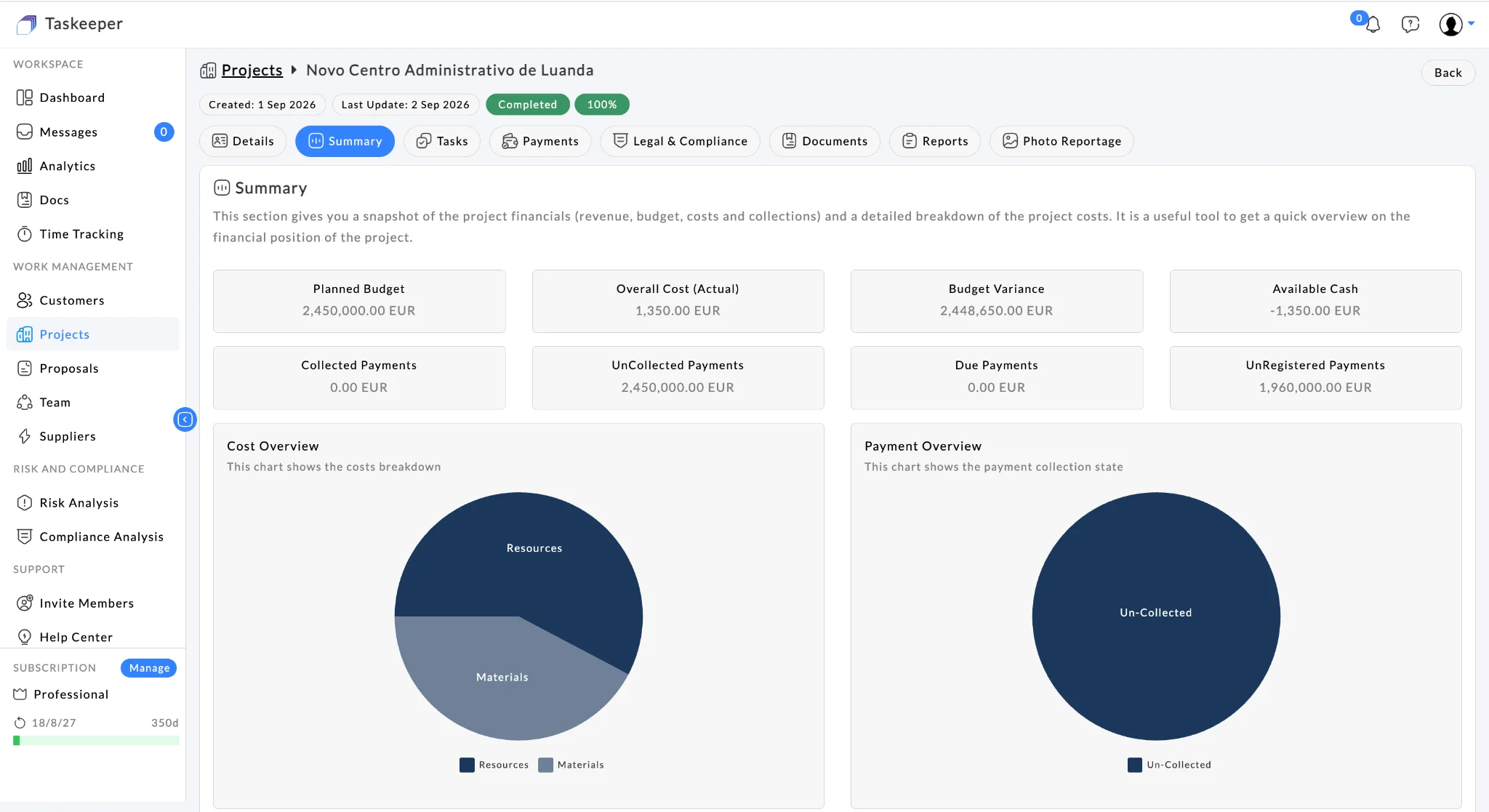
Project summaries expose budget, actual cost, variance and payment position without separating them from the project itself.
Project summaries expose budget, actual cost, variance and payment position without separating them from the project itself.
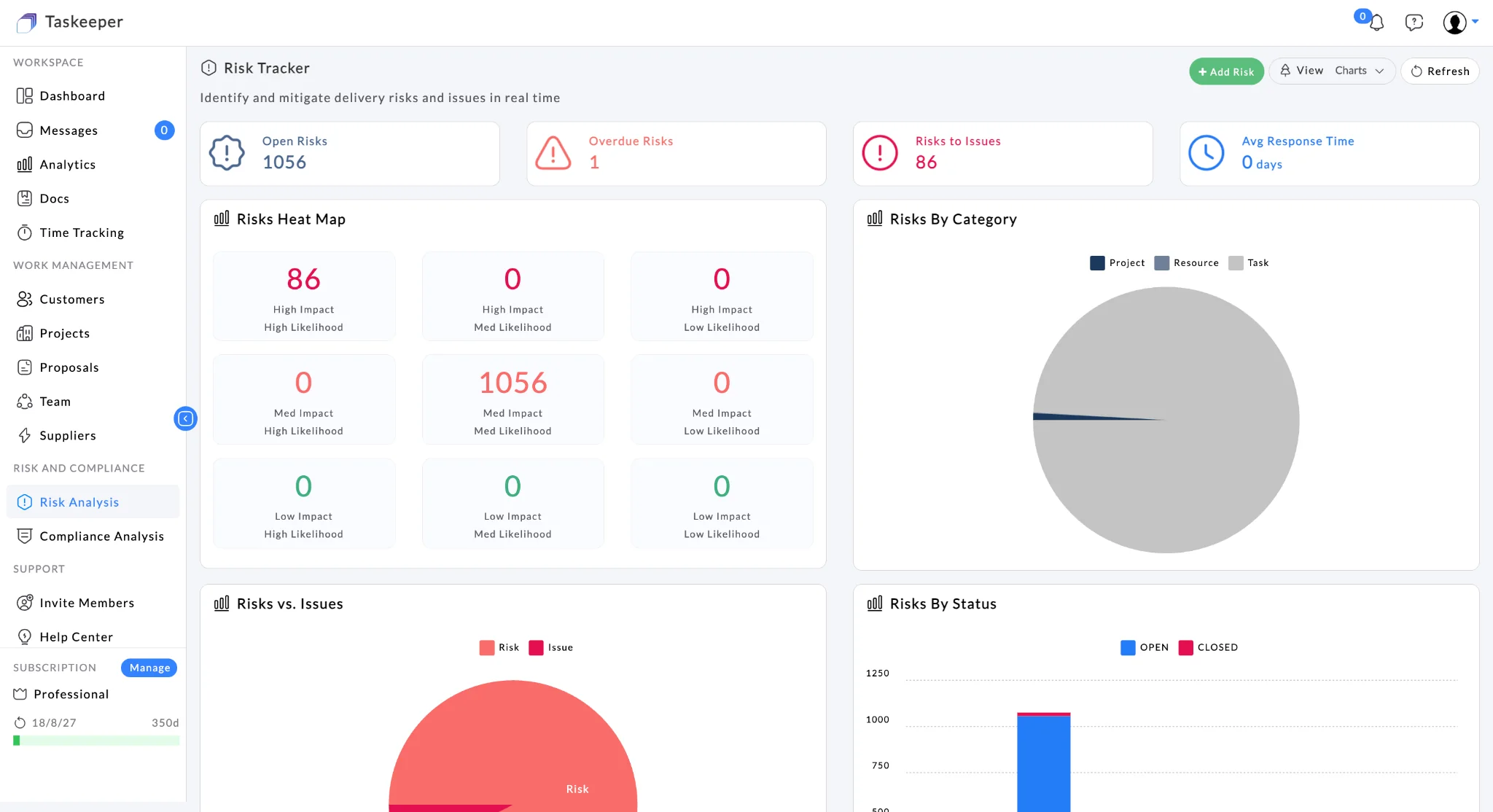
Risk charts help leadership see concentration and status before escalation.
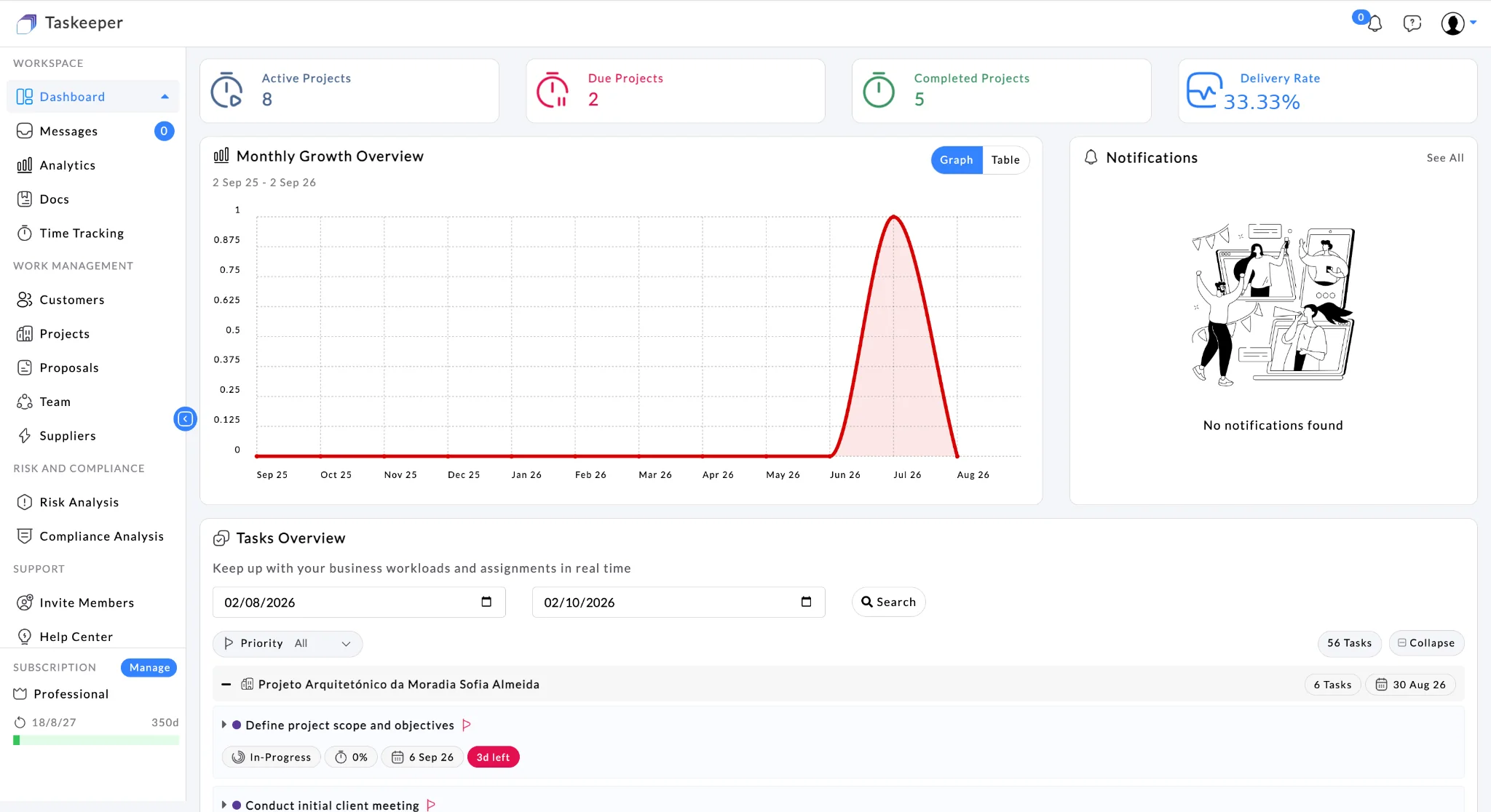
The dashboard supports a high-level view of active, due and completed projects.
An owner-developer oversees eight active developments delivered by multiple external teams. The development director needs consistent project, budget, payment, risk and compliance information without becoming the day-to-day task manager for every contractor.
The problem is not a lack of software. It is that the operating picture is fragmented across too many places.
The same customer, project, people, commercial and governance context can support decisions from planning through delivery and closeout.
Taskeeper is designed so each capability becomes more useful when it shares customer, project, people and commercial context with the rest of the workflow.
Review active projects and delivery position from one environment.
Keep planned budget, actual cost and variance accessible.
Track milestone amounts, registered and unregistered payment values.
Review open risks, likelihood, impact, mitigation and escalation.
Use project-level compliance status alongside delivery oversight.
Use current operational information as the basis for reporting.
Taskeeper supports distinct user profiles for company administration, project delivery, operational team members, clients and suppliers. Client access can be configured so customers follow a
→Taskeeper can use project location to surface relevant legal, safety and regulatory requirements for supported markets, helping teams understand what is required, who owns it, what evidence
→Capture progress evidence from the exact project or task and keep it organised with the work. Taskeeper stores the project/task context, uploader, timestamp, tags and description so visual r
→Communicate with colleagues, project teams and authorised clients inside the same operational workspace where the work is managed — reducing the need to scatter project context across person
→Taskeeper is designed to fit into an existing technology landscape rather than creating another data island. Standard onboarding can start with import/export templates, while ongoing integration can use APIs or CSV-based exchange.
Download the Taskeeper Excel import/export template, populate it with your existing customer, project, resource or other supported data, then import it back into Taskeeper.
Use Taskeeper APIs for system-to-system integration, or consume and produce CSV files where a lightweight data exchange is sufficient. This supports gradual adoption without forcing every surrounding system to change at once.
Role-based permissions, MFA, SSO/SAML, encryption in transit and at rest, audit logging, backups and disaster recovery, security monitoring, vulnerability management, incident response, API security, least-privilege access, data retention/export/deletion controls, GDPR/DPA support and multi-company segregation are part of the launch security model.
No. Taskeeper can also support developers and owners that need portfolio, project, commercial, risk and compliance visibility without managing every delivery detail.
Taskeeper includes risk tracking and chart views that can help teams review risk status and concentration across work items.
Yes. Project summaries and payment views keep budget, cost and payment context close to delivery information.
Enterprise capabilities include multi-company environments, advanced roles and administrative controls.
Bring one real workflow to a demo and map it to the Taskeeper capabilities that can create value first.